Environment and people in the Holocene Atacama.
One of the driest places on Earth. A story of small moisture shifts that opened and closed the desert to the people trying to live there.
The question
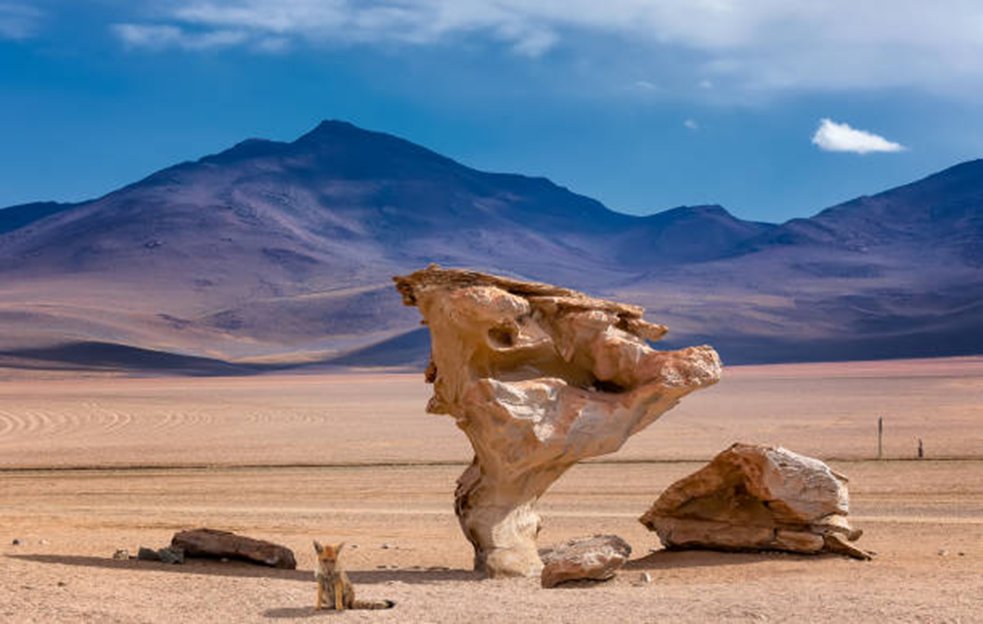
The Atacama is often called the driest place on Earth. Ritter and colleagues document that its hyperarid conditions have persisted for at least 215,000 years. But the Atacama is not uniformly dry, and within the overall aridity, small shifts in moisture have opened and closed different parts of the desert to human occupation.
This project asked how Holocene climate shifts lined up with the archaeological record. When moisture returned to the interior, did people follow it? When the interior dried out, where did they go?
Method
The paper synthesized eight peer-reviewed sources across paleoclimate and archaeology, weaving together:
- Pollen records showing which plants grew when, and by extension how much moisture was available
- Lake and wetland sediment cores documenting past water levels
- Preserved wood from early Holocene groves in basins that are now bare
- The archaeological record of site distribution, mortuary practices, and subsistence strategies
The goal was not to produce new data but to integrate multiple lines of evidence into a coherent narrative of human-environment interaction across three Holocene phases.
What the record shows
The early Holocene, roughly 13,000 to 10,000 years ago, was slightly wetter than today. Pollen records and preserved wood from the interior suggest that parts of the desert that are barren now held patches of vegetation and small groves of trees. People could move through the interior, coast, and highlands in a flexible loop, using each zone seasonally.
The middle Holocene, roughly 9,000 to 4,000 years ago, was profoundly dry. Grosjean and colleagues document lake sequences where the lake fully desiccated during this window. With the interior largely unlivable, people concentrated along the coast and at high-altitude wetlands. The Chinchorro mortuary tradition, with its elaborate black and red mummies, reaches its peak during this time, a sign that the coast was stable enough to support intensive ritual labor even as the interior emptied out.
The late Holocene saw moisture return in a patchier form. Interior wetlands reactivated, and the Pampa del Tamarugal developed into a structured network of oasis nodes connected by recurring travel routes. People added small-scale irrigation and camelid herding, creating a more interconnected landscape than the middle Holocene had allowed.
What I took from it
The story the Atacama tells is not one of collapse or breakthrough, but of long, patient adjustment. People did not conquer the desert or flee it. They read it carefully and moved their lives around its slow changes in water availability.
Writing this paper shifted how I think about environmental determinism. Climate sets the outer limits, but inside those limits, human strategies, social networks, and technology do enormous work. The middle Holocene was harsh, but it was not a dead zone. It was a period when people pulled in toward the parts of the landscape that still worked, and built elaborate cultural lives there.